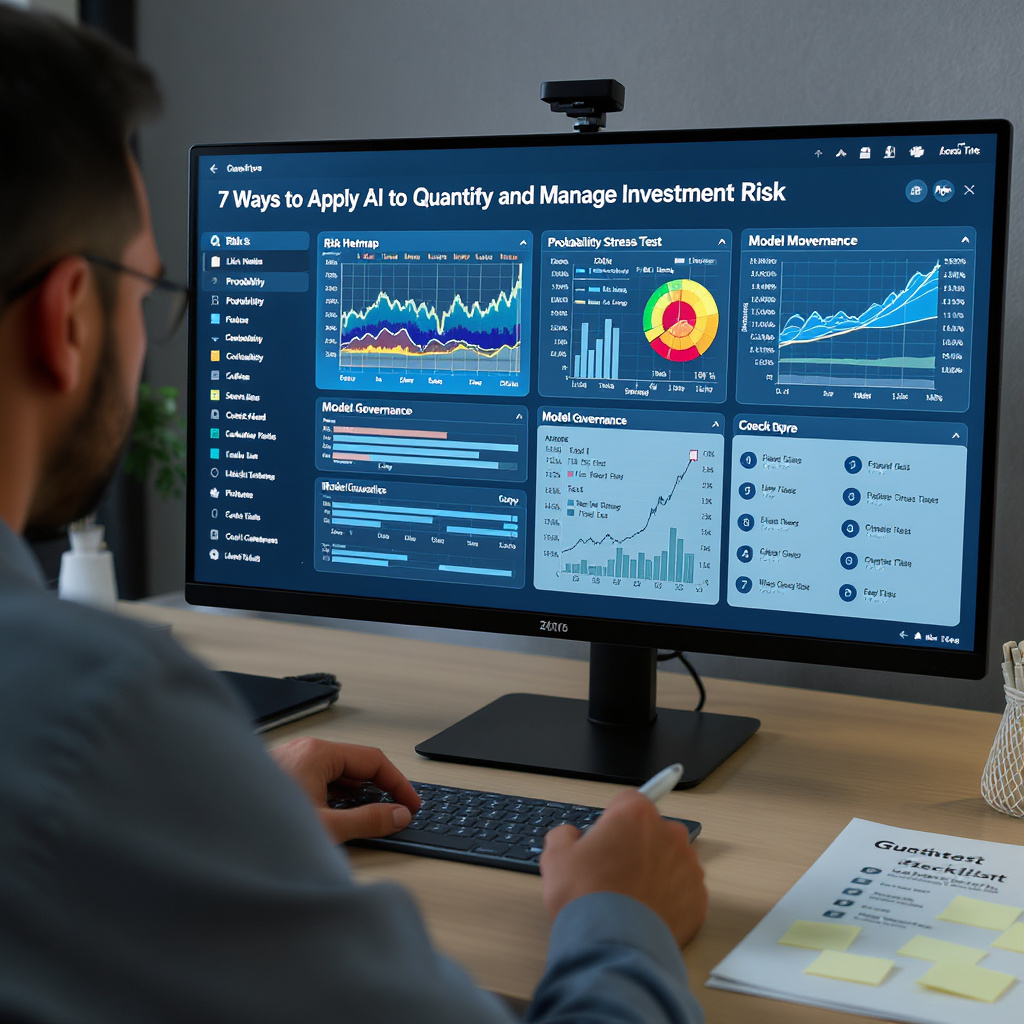
Quick intro: Practical, actionable steps for portfolio managers, CROs and fintech teams to adopt AI in investment risk — with controls, measurable outcomes and regulatory alignment.
1. Define risk targets and data needs. Start with explicit metrics (VaR, expected shortfall, drawdown limits) and a data inventory. Enforce lineage, timestamp alignment and quality checks so every signal is auditable.
2. Choose models and parsimonious features. Combine baseline econometric models (factor regressions, time‑series) with ML ensembles and targeted NLP for alternative data. Favor compact feature sets, regularization and PCA to limit overfitting.
3. Validate, backtest and explain. Use walk‑forward backtests, event replay and stress scenarios. Apply explainability tools (SHAP/LIME) and preserve training snapshots so outcomes are interpretable and auditable.
4. Operationalize with governance and monitoring. Implement model inventories, versioning, CI/CD for recalibration, realtime drift detection (PSI/KL) and clear escalation pathways with rollback controls.
5. Secure data and do vendor diligence. Protect pipelines with encryption, RBAC and privacy techniques (anonymization, federated learning, differential privacy). Require SOC reports, penetration tests and contractual SLAs for third parties.
6. Apply AI to stress testing, credit and liquidity. Use regime‑aware simulators, conditional copulas and transaction‑level signals to generate realistic stress paths, early‑warning credit indicators and short‑horizon liquidity forecasts with confidence bands.
7. Start small, measure economic value, scale responsibly. Pilot a narrow use case with clear KPIs (VaR breach reduction, alpha bps, capital charge improvements). Expand only after independent validation, audit trails and stakeholder sign‑off.
Bottom line: Pair disciplined data stewardship, transparent modeling and rigorous validation so AI augments risk decision‑making without sacrificing oversight, auditability or regulatory compliance.